KJ Hannah Greenberg,
Do Not Compete With Evil Doers
excerpt
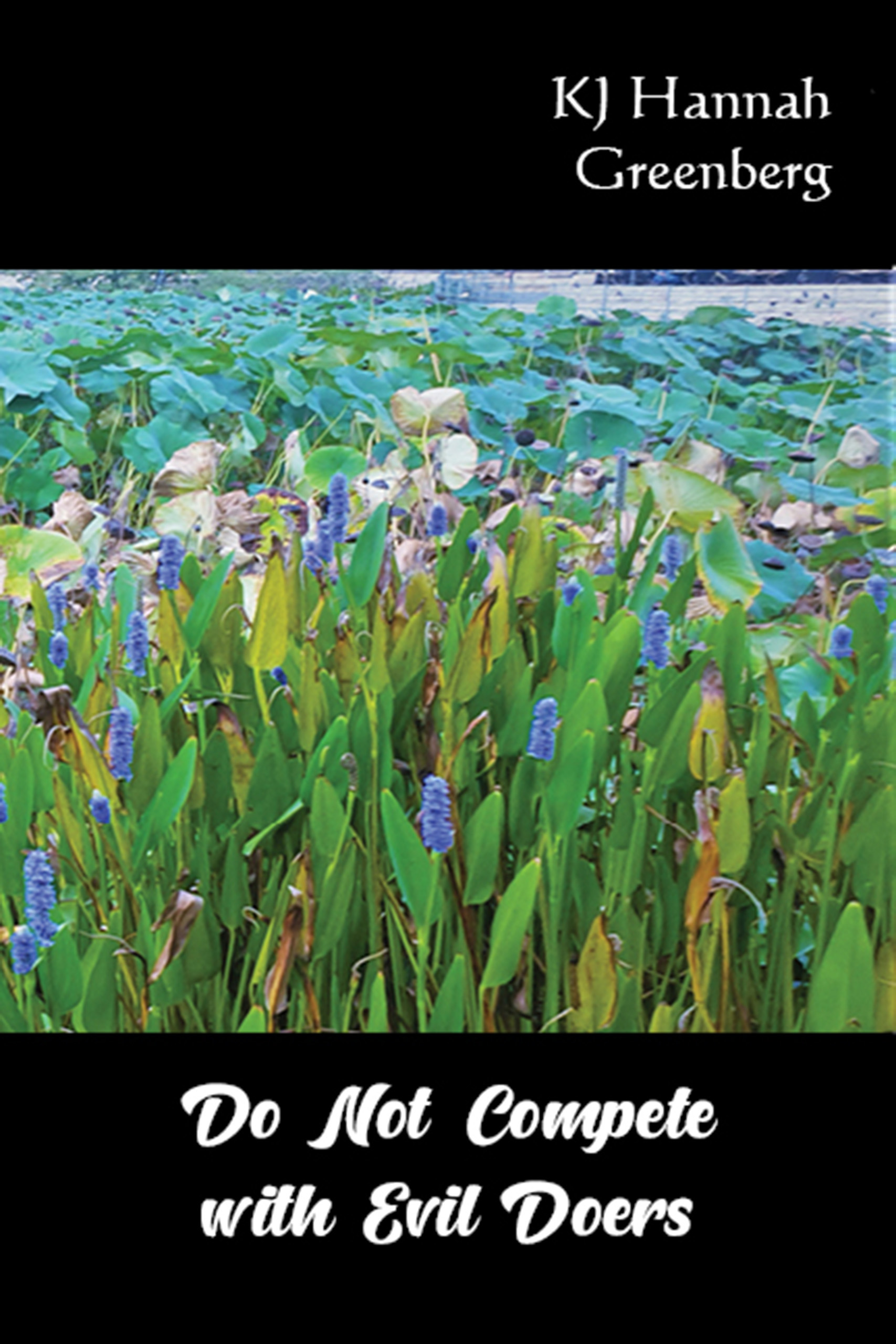
Do Not Compete With Evil Doers Publisher: Seashell Books Date: Dec. 29, 2025 Length: 241 pp. ISBN: 979-8241575456 |
Retirement age is often about empty nesting and grandchildren. In some cases, it is equally about war, facing down international prejudices, and coping with increased disability. Likewise, getting older might bring along late applications of professional skills, newfound gratitude for being alive and for the small and large miracles that constitute daily existence, and a measure of nostalgia for personal and social history. This essay collection, Do Not Compete with Evil Doers explores all of these topics.
Excerpt: Madame Dictionary
I’m retired from academia. I no longer present research at conferences and I haven’t graced the front of a university classroom for a long time. Instead, I devote my hours to fulfilling book contracts. Irrespective of the exact application of my skills, lifelong, I’ve retained a love for words. In fact, in high school, I was taunted by my peers with the catcall “Madame Dictionary.”
What’s interesting is that fifty years ago, when I was an adolescent, there was no Internet. Writers were unable to click when seeking word families capable of capturing the nuances of their sentiments. Rather, folks who put pen to paper or who used typewriters, edited their compositions with the aid of clothbound thesauruses. Most people, though, forwent such stringency.
Admittedly, when I grew older, i.e., when I became a college co-ed, I attempt to compose with that sort of book balanced on my lap. I misjudged what made writing fluid. I erroneously believed that “offbeat” bested “regular.” Hence, I repeatedly failed to rely on my natural vocabulary and, instead, counted on my professors being impressed with my odd verbiage.
The other way around, later, when I became a professor, I encouraged my undergraduates to think mindfully about their word choice. I emphasized that their diction needed, in the least, to appear natural. I lectured that links among nouns and verbs must be subtle enough to be imperceivable. Some of my students heeded my advice. Others did not. Correspondingly, some earned high marks in my courses while the others didn’t.
Tens of years later, when I conducted private writing workshops, I directed my students to polish and then to repolish their words. One or two dozen passes over a manuscript, I explained, ought to become their norm. Further, I taught them that an exposition’s tone, per se, depends on its author’s attitude as well as on its author’s lexes. I tried to teach those newbies that stilted language is more of a bramble patch than informal language, i.e., than slang.
Some of my workshop attendees accepted my guidance. Others did not. Beginners who listened to my instructions found publishers for their work. Those who didn’t found their inboxes filled with rejection notices.
Rabbi Judah Mischelmore expands on this concept of parsimonious language in “Re’eh: Take a Look.” He writes that:
[t]here is a fine line between a healthy sense of self, gadlus ha’adam, confident self-esteem and arrogance. An honest reckoning of our human frailty and imperfections as well as our shortcomings and flaws ensures that we stand before Ribbono Shel Olam with appropriate humility and contrition. With an unchecked ego, we can easily get in our own way (Mischel, 39).
More accurately, it’s one type of misstep to build word castles to pronounce oneself “consummate;” it’s another to approach writing, particularly, or life, more generally, with an attitude of entitlement. The former is the route of the unenlightened. The latter is the path of the loathsome.
Recently, when I was assessing a manuscript for a literary journal, I realized that the submitter had used AI to create his “masterpiece.” A little cyber sleuthing revealed that the author was a teen who was keen on amassing awards and honors. Sigh.
After asking my supervising editor to run the youth’s submission through apps capable of checking for plagiarism and for AI-constructed materials, I requested something more. Please, I urged my superior, send that youth tome for tutoring, gratis. Someone clever enough to use AI as a workaround might also be clever enough to learn genuine writing skills (I recalled my own adolescence when I had filled papers with “big words” chosen from a thesaurus because I believed my acts were the epitome of cleverness.)
Thoughtless people will continue to be impressed by unusual or multisyllabic terms. Regardless of whether they understand what’s been written, such folks will carry on assigning kudos to “writers” who seem to have integrated the better part of phrasebooks into their scrawlings. Fools revere dissemblers even if those objects of their admiration are practicing prestidigitation or have no actual idea of what they’re communicating.
Conversely, wiser sorts appreciate that gradations of meaning are possible through ultra-fine coloring of words. They value, as well, that straightforward language almost always gets the job done. There’s little honor in being compared to nomenclators. It’s direct communication that’s best!
Copyright © 2025 by KJ Hannah Greenberg