The Artist of Total Absorption
by Mike Rogers
part 1
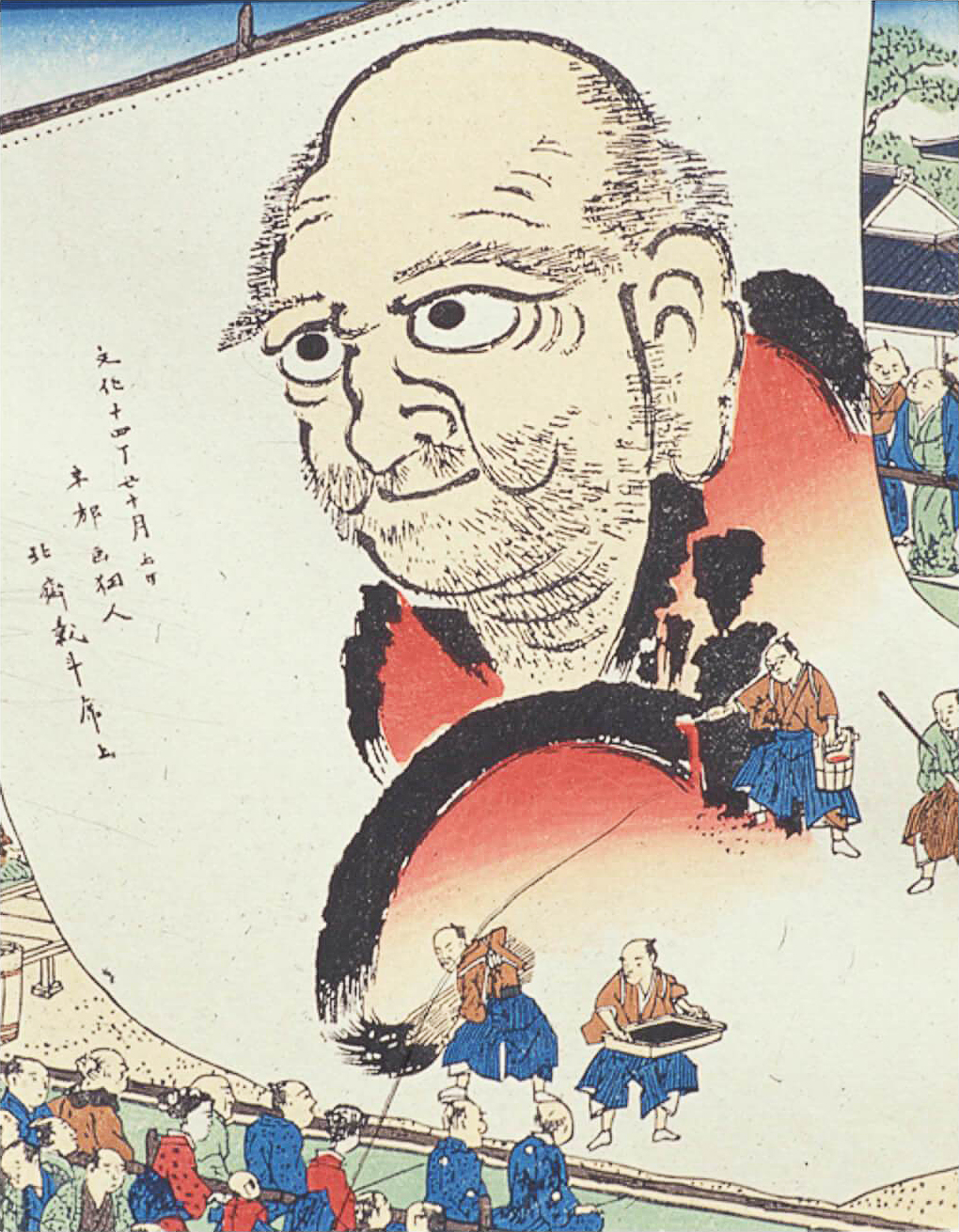
Names? Do you want names? Everybody wants names! As though a name makes any difference... Take me, now: I have had so many names in my lifetime. When I made my first works, my master called me Shunrō, I became Tawaraya Sōri, when I moved on, but then I left that to one of my pupils, and became Hokusai, Hokusai who painted The Great Daruma with brooms and buckets of ink, Hokusai who chased a chicken whose feet had been dipped in red ink across a great blue curve he had painted to show how maple leaves in autumn floated down a river.
Then I called myself Taito and published books to share my skill in drawing and also to show it off. I have to be honest; they were sketches of this and that, plain lines that had so much more inside them.
|
Then I painted The Great Daruma again, to remind those who had seen me do it before and to impress those who didn’t believe it had been done and to honour the saint who had brought Zen Buddhism to Japan.
Litsu was the name I gave myself when I fell in love with Fuji and water, water as it falls down, water as it rears up, water, too, in gentle waves and ripples, and water in froth and spray that fill the air.
Then I found the true name for the man I had become, Gakyō Rōjin Manji, The Old Man Mad About Art. From the age of six, I had a passion for copying the form of things and, since the age of fifty, I have published many drawings; yet, of all I drew by my seventieth year, there is nothing worth taking into account.
At seventy-three years I partly understood the structure of animals, birds, insects and fishes, and the life of grasses and plants. And so, at eighty-six I shall progress further; at ninety, I shall even further penetrate their secret meaning and, by one hundred, I shall perhaps truly have reached the level of the marvellous and divine. When I am one hundred and ten, each dot, each line will possess a life of its own.
But all these facts, though interesting, are not what you want to know. Nonetheless, if you know nothing about me, you will be unable to assess the nature of the story I want to tell you. Perhaps “want” is wrong, because it is not pleasant even though it is instructive, and that is why it is a story that I feel obliged to communicate.
The wealthy farmer, Takai Kazan, offered me shelter on his farm in Obuse, which an eighty-three-year old was glad to accept, since it represented freedom from the pressures of life in the capital, from the need to produce images which could be printed and sold, from the requirements of pleasing not only purchasers but also publishers, who could be much more fickle and unpredictable.
And so I could turn back to painting, think only about art and never about commerce.
In the evenings, Takai Kazan and I discussed art and artists in a friendly and shallow way, and he told me that not far from his own farmhouse there lived a potter who had a fine reputation among connoisseurs, many of whom made long journeys to acquire his wares. How different, I thought, from my own experiences! The value of these pieces rested in their rarity, whereas such material advantage as I had acquired came from the number of reproductions that I could sell.
Such envy as I felt — and, since I was a true Buddhist, it was small, no more than a memory of what I knew I had felt during the more competitive years of my earlier life — it was, however, quite driven away by the rest of what Takai had to tell me.
The potter, it seemed, had retreated to the area to avoid the scandal that had grown around him when he resided in a more populous district, where neighbours had observed disquieting circumstances in the way he lived his life.
Being curious about all things, as becomes an artist in love with the physical world, not least because of the metaphysical beyond it, which strives to express itself through it, in which project a true artist should offer all possible assistance, I asked Takai if he had any clearer idea of what the problem had been. And he told me.
“He beat his servants. I say ‘beat,’ but I think it was a lot worse than that. If a servant is lazy, you beat them once, to remind them not to be lazy. If you find that you have to beat them again, then you should discharge them at once, because they will never learn or, at least, not from you. I treat my servants well, and they work well for me out of loyalty and gratitude, because they know that, if they fall ill, I shall do my best to have them healed. If they die — which has happened, alas — then I shall see that their dependents do not suffer; and, if they wish, take them into my service. That is a surer bond than any threat of violence.
“This potter — well, my wife enquired among women in the market about him, because I had thought of inviting him here to our home. Art is, as you well know, an interest of mine, but she heard such tales of horror that she refused to have his foot cross our threshold. No woman, she was told, would dare work for him, however poor or desperate for employment she might be, for fear of what he might do to her.”
“So, he has no servants, then,” I asked, “and must make shift to do everything for himself?”
Takai pulled a face, as if he had bitten into a fruit he had thought would be sweet, but which tasted sour and rotten. He looked as though he would rather have spat out what was in his mind than give it utterance but, out of politeness, he answered my question.
“There is a boy. I have made my own enquiries, since, as a merchant in my own produce I have connections in the place where the potter formerly had his residence, in the hope that there might be relations who could intercede and rescue the lad from what is not merely servitude but abuse. However, it seems he is an orphan from a low family, who may, indeed, simply have sold him to the potter and spent the purchase-money on saké, before escaping from the district where they were about to be arrested for debt... There is no help to be hoped for from that quarter.”
There was silence between us, which Takai broke, the words issuing from his mouth with extreme reluctance. “I attempted to intervene, calling to the potter from the fence at the edge of his compound, when I saw him inspecting his kiln. I told him that my wife was upset, her sleep disturbed, by the cries of his boy when he beat him.”
“Was that true?” I asked.
“I could hardly admit that it upset me, could I? The potter is a big man, much bigger than me, and he had an iron-shod staff in his hand, no doubt to adjust something in his kiln, but to me it looked like a weapon, and had I offended him, he would have used it as such.”
“And what was his response?” I asked.
“He said, that if the noises were really that troublesome, then he would have to cut out the boy’s tongue, but he would rather not do that, since then he would have to teach the boy to write, in order to get answers to his questions, which would be a waste of everybody’s time.”
I let the silence grow for a little while, before I asked, “And what did you answer to that?”
“I said, in that case we would move our sleeping accommodation to the other side of the house, and see how the situation developed.”
I could see tears in Takai’s eyes, so I usurped his hostly duties, filled his cup with saké and passed it to him, so that the action of drinking excused his inability to speak. When conversation resumed, we avoided the subject completely, discussing the quality of the saké, the weather prospects for the next day or two, and what subjects I might choose for drawing, out of those which offered themselves in and around the farmhouse.
I listened carefully that night, but heard nothing. Age is sometimes reputed to make one a light sleeper, but I have usually found it easy to slip from shallow meditation into the realm of dreams, from which I sometimes return precipitately with visions I must hasten to sketch before they fade. I heard nothing untoward during the day, either, and was happy to let the whole subject drop. Every morning, I painted Chinese lions with ink on paper, as talismans against misfortune, hoping, perhaps, that their protection would stretch beyond the bounds of the house in which I was staying.
A week later, it must have been, I saw a rich man riding to the potter’s house. How did I know he was rich? The quality of his clothes, the quality of his mount — and I knew, too, that he did not want to be observed — not in a carriage, not in a litter, a solitary expedition, servants waiting for him back at the inn, no doubt.
A connoisseur, I thought, a collector of fine porcelain, come to make a secret purchase. Unlikely to be someone who would care about the way a servant was treated, if the resulting pottery tickled that particular overdeveloped organ which responds to art — overdeveloped in me, too, no doubt, though I retain a livelier involvement with the world itself than these people manage; at least, I flatter myself that I do.
I told Takai I was going for a stroll, and I did just that, walking up to the fence surrounding the potter’s compound with some sketching materials in which I appeared to be absorbed when the rich connoisseur arrived, so that he could readily ignore me, and I could notice, without seeming to do so, that it was a slight young man who welcomed him and not a burly potter strapping enough to intimidate my amply built host.
I had been quite right in thinking that my completely realistic “disguise” as an artist would attract the pottery-lover’s attention, so that I would not need to contrive any way of meeting that would lead to a conversation.
Leading his horse by its bridle, he paused to look over my shoulder at my sketch of the leaves immediately in front of me. He nodded in approval. It was a genuine gesture. There were only the two of us there. It may not have been the genre to which his passion was dedicated, but he recognized art when he saw it, hence his instinctive reaction, over which he had no control. He made a gesture with his free hand, inviting me to show anything else I had.
|
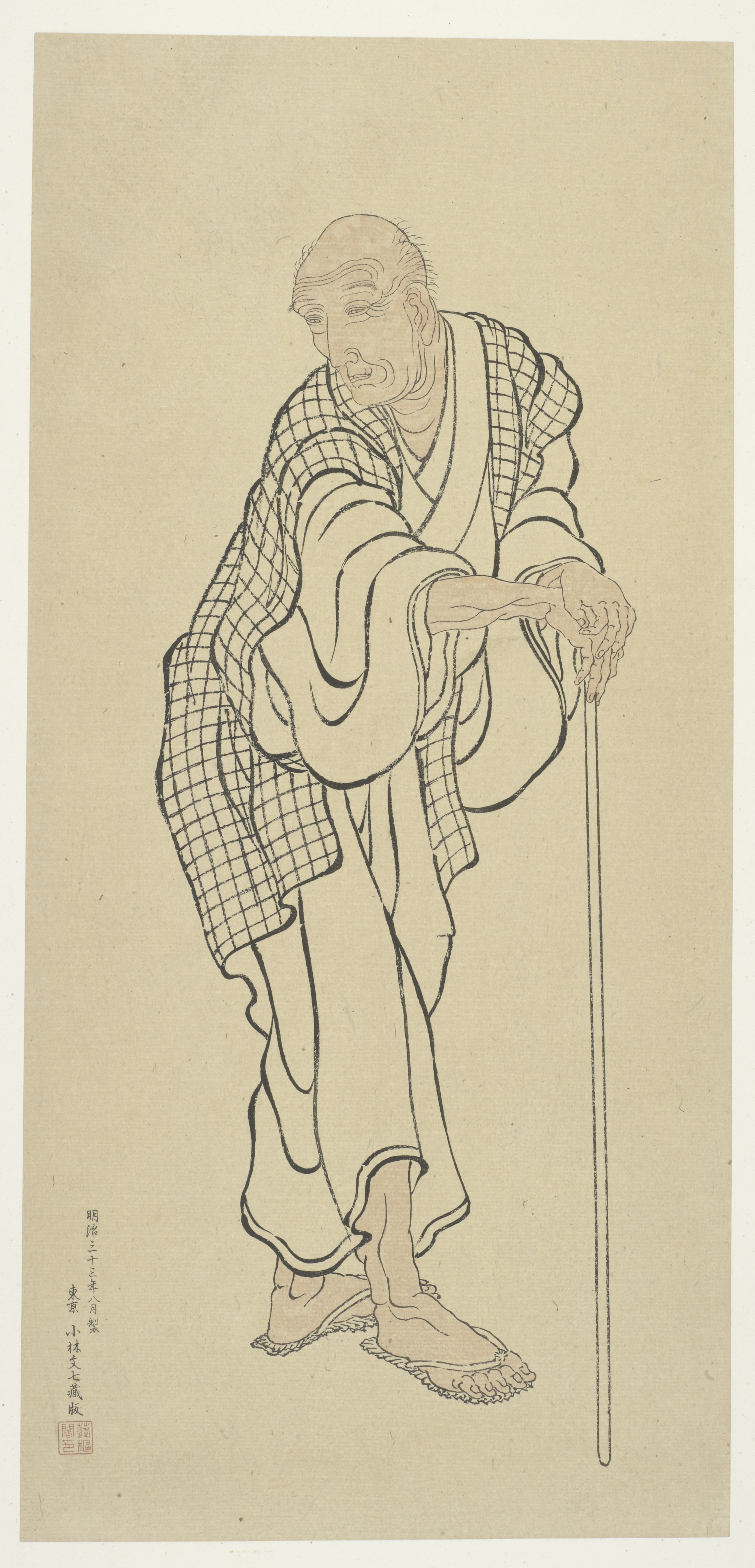
Perhaps it was mischievous of me, but I had thought ahead and brought out among the sheaf of drawings in the small portfolio that I used as a firm surface to rest on while sketching out of doors a self-portrait in pen and ink that I had recently completed, with a title in the bottom left corner: “The Old Man Mad About Art.”
He read it aloud and laughed. “That might almost be me,” he said, “riding all this way to buy a pot or two!”
“It is the name that Hokusai has given himself,” I said, “now he has entered his ninth decade.”
|
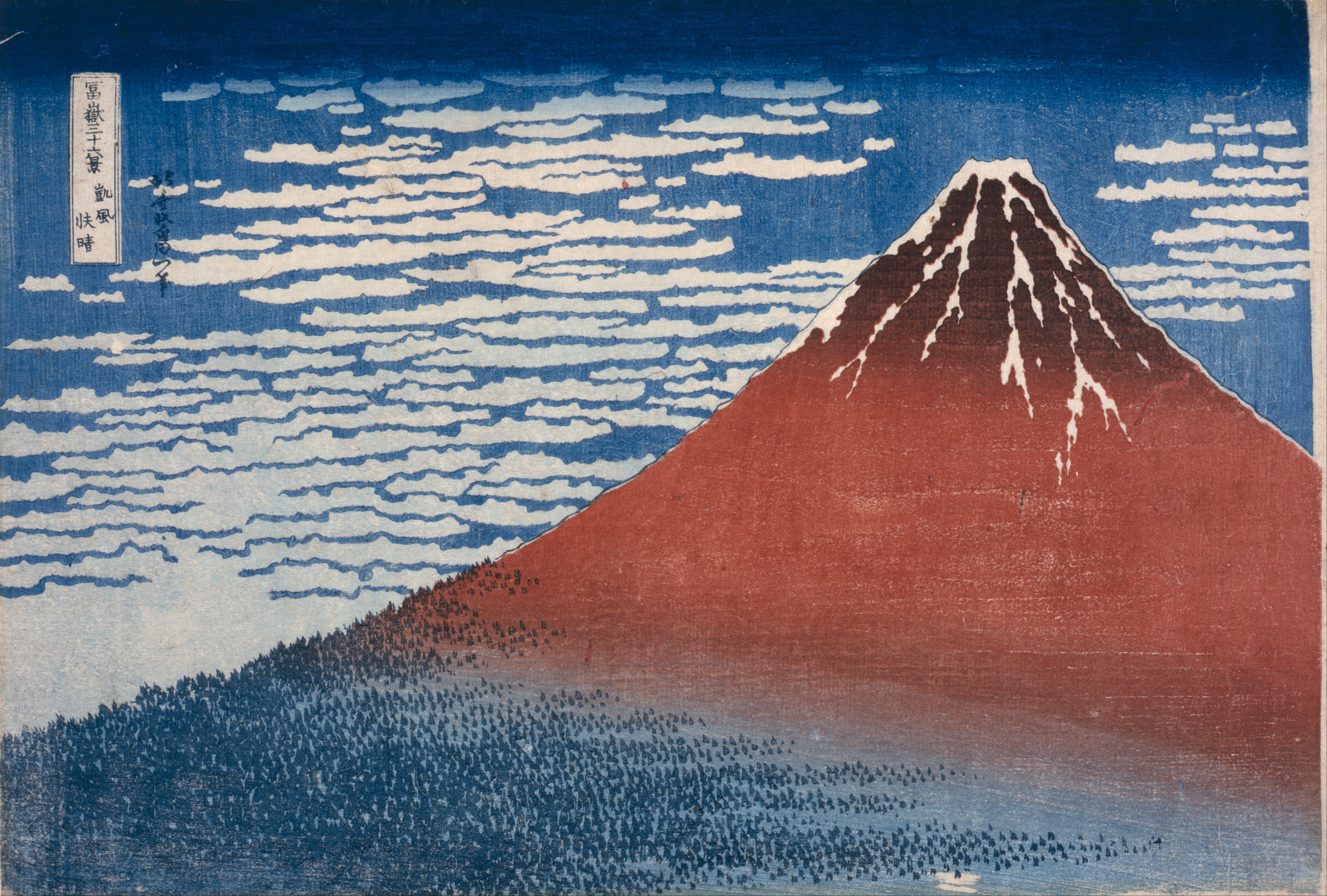
“Hokusai?” he queried. “Is he still alive? The man who drew all those dirty pictures, and made Fuji look like a giant nipple?”
“That’s the one,” I said. “I know him slightly. But I can see that you have a much more refined taste, good sir. Would I be going too far in asking if I might have a peep at the exquisite examples of the potter’s art you have in your saddlebags. I am always anxious to increase my capacity for appreciation.”
* * *
Copyright © 2026 by Mike Rogers