Sax Rohmer, Egyptomania,
and Late Imperial Gothic
Review Article
by Grove Koger
Englishman Arthur Henry Ward (1883-1959) wrote a number of popular novels and stories under the pseudonym Sax Rohmer. His most famous series involves a Chinese character named Fu Manchu, a patriot bent on freeing his country from Western domination. Of course, he’s seen by his foes in the West as evil incarnate.
Rohmer has long been attacked for what are viewed as his racist stereotypes but, in fact, virtually all his characters are stereotypes of one kind or another, including the bluff Sir Nayland Smith. The latter and his various successors are repeatedly outwitted by the “evil” Chinese doctor, who surpasses them in both intelligence and sense of honor, factors routinely overlooked by Rohmer’s critics. Fu was in fact what would later be called a “freedom fighter” and deserves to be considered in that light.
|
But Rohmer also wrote several works set in Egypt or dealing with devious — and sometimes supernatural — Egyptian designs on England and its institutions. He routinely employed Egyptian props — mummy cases and the like — throughout his works. In fact, his first published story was “The Mysterious Mummy,” which appeared in 1903 in Pearson’s Weekly.
Rohmer can be seen as a late entry in a category that literary critics have identified as “Imperial Gothic.” According to the definition in the online SFE: The Encyclopedia of Science Fiction, the term describes a “complex of motifs, venues and paranoia-inducing utterances whose main burden” is “that the Western world is under deadly attack from outside its borders.”
The entry mentions Patrick Brantlinger’s 1888 study Rule of Darkness: British Literature and Imperialsim, 1830-1914, which explains the category as beginning with the publication of H. Rider Haggard’s 1885 novel King Solomon’s Mines. The writer also mentions Rohmer’s works as demonstrating “the longevity of a popular but potentially toxic ‘network of belief’ that can too easily become a form of denial.”
Rohmer’s interest in and use of Egyptian material recalls two other books published during the years immediately preceding the turn of the century that fit the Imperial Gothic mold. One is an 1897 novel set in London and Egypt that few outside the horror field will have heard of: The Beetle, by Richard Marsh. Tastes — and times — differ, but it’s written in what I can describe only as a “hysterical” style. From our vantage point in the twenty-first century, the only striking thing about it is that it initially outsold Bram Stoker’s Dracula, which was published in the same year.
Another example of Imperial Gothic with an Egyptian flavor is Guy Boothby’s Pharos the Egyptian (1899). Here an “undead” Egyptian priest intones an ominous warning: “Ah, my nineteenth-century friend, your father stole me from the land of my birth and from the resting-place the gods decreed for me; but beware, for retribution is pursuing you, and is even now close upon your heels.” That’s pretty good but, to me, Boothby’s padded prose eventually grows tiresome.
Yet another little-known novel that deserves brief mention here is Stoker’s own Jewel of Seven Stars (1903), a frustratingly static narrative that falls far short of the intensely dramatic Dracula.
These three novels, as deservedly forgotten as they are, capitalize on a recurring fascination with things Egyptian on the part of Britons and other Westerners. This “Egyptomania,” as it’s been called, washed ashore in several substantial waves. One followed the opening of the Suez Canal in 1869, an event that established a lifeline between Britain and the “jewel” in its imperial crown, India. Paradoxically enough, however, the event led in turn to a wave of anxiety over the very vulnerability of that lifeline, one centred on the “mysterious” land through which the Canal passed. Another wave of Egyptomania followed the 1922 discovery of Pharaoh Tutankhamen’s tomb.
Published several years after the novels by Marsh and Boothby that I’ve mentioned, Rohmer’s works involving Egypt constitute what we might call Late Imperial Gothic. Rohmer’s characterization was seldom more than facile, and his actual knowledge of the country seems to have been haphazard, but he was fascinated by Egypt and visited it several times.
On the first occasion, with his wife, Elizabeth, in 1913, Rohmer had arranged for ship and hotel accommodations (hrough the travel agency Thomas Cook & Son from Southampton to Cairo and Luxor via Port Said. On the evening of their arrival, the couple happened to meet Rex Engelbach (1888-1946), the chief-of-staff of the famed Egyptologist Flinders Petrie.
|
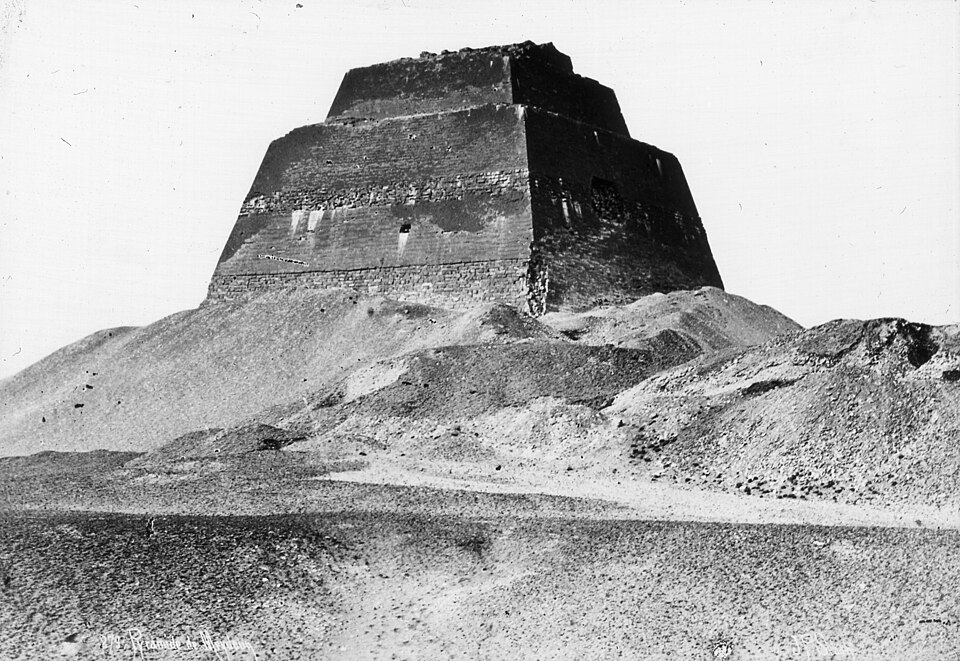
Thanks to this chance meeting, they were able to inspect the burial chamber beneath the little-known step pyramid of Méydûm, which they reached after what was apparently a tortuous, horrifyingly claustrophobic descent on hands and knees down a long, exceedingly narrow tunnel.
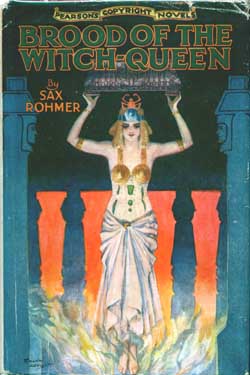
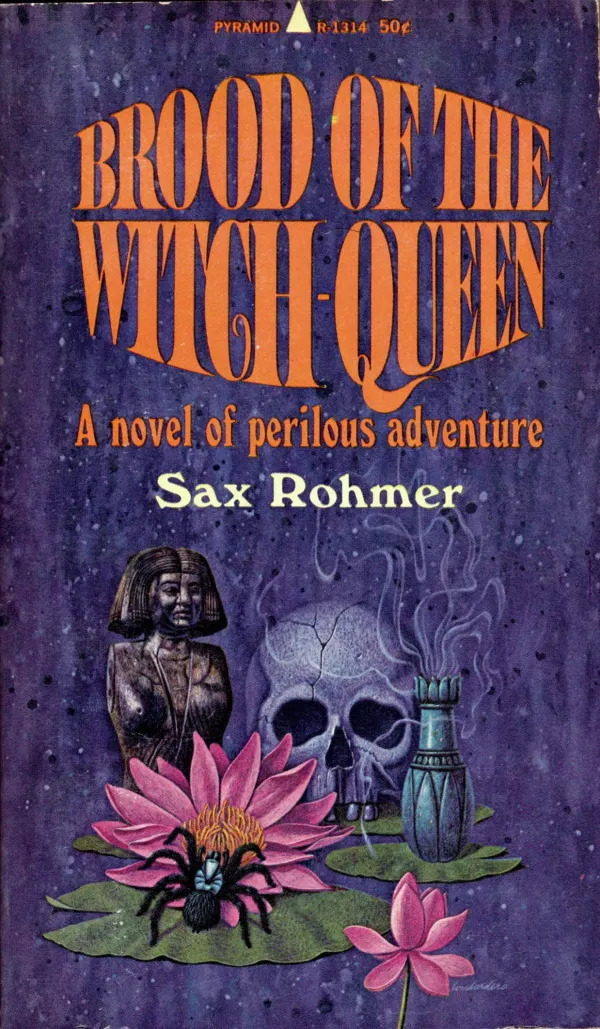
The best of Rohmer’s Egyptian works is Brood of the Witch Queen (1918). Here a reincarnation of an immortal being, the offspring of the “Witch Queen” of the title, has taken up residence in the heart of London. Thwarting him is a “tall, thin Scotsman,” Robert Cairn, who undergoes what his father, a learned doctor, refers to as a “saturnalia of horror” involving a clutch of carrion-eating Dermestes beetles (Dermestidae spp.) taken from the skull of a mummy.
|
The ordeal results in Robert’s heading to — wouldn’t you know it! — Cairo for a “rest-cure.” As it turns out, however, a “thing very evil,” as a fortune-teller puts it, has entered the city before him. The most vivid scenes in the novel involve a visit to the pyramid of Méydûm and a fictionalized replay of the experiences that Rohmer and his wife had endured on their own visit in 1913.
In Living in Fear: A History of Horror in the Mass Media, Les Daniels praises Brood, noting that “Rohmer’s occult lore was never as well employed as in this tale [...] and he never equaled the claustrophobic chills of the scenes in the bowels of a pyramid.”
David Huckvale devotes several pages to Rohmer in his study Ancient Egypt in the Popular Imagination, and describes the novel as “gloriously lurid.” In his entry on Rohmer in Horror Literature Through History, Will Murray refers to the novel as the writer’s “acknowledged masterpiece,” while Allan Warren, writing in Supernatural Literature of the World, calls Brood the “most successful” of Rohmer’s genuinely supernatural novels.
Rohmer turned to Egypt again in Daughter of Fu Manchu, originally titled Fu Manchu’s Daughter, 1931. It is the fourth book in his Fu Manchu series and one of the best. Here, the author has replaced his earlier narrator, Dr. Petrie, with archaeologist Shan Greville, who has sought out Petrie in order to accompany him to the site of an archaeological dig at the Tomb of the Black Ape in the Valley of the Kings, where another Egyptologist, Sir Lionel Barton, has died under mysterious circumstances. (After a time, one learns that in Rohmer’s universe, circumstances are almost always mysterious.
Present are Fu’s early foe, Sir Denis Nayland Smith (formerly Police Commissioner of Burma, but now Assistant Commissioner of Scotland Yard) and Superintendent Weymouth (formerly of the Criminal Investigation Department but now a police superintendent in Cairo). Rohmer’s decisions to switch narrators and age his otherwise familiar characters add a certain depth that was missing in the first three volumes of the series. Sections of the fifth instalment in the series, The Mask of Fu Manchu (1932), are also set in Egypt.
Another work by Rohmer that can be considered in this category is Tales of Secret Egypt (1918), one of whose stories, “The Death-Ring of Sneferu,” involves yet another perilous visit to the Méydûm Pyramid. Six of the stories — or “tales,” as Rohmer calls them — involve an Egyptian named Abû Tabâh and an Englishman, Neville Kernaby, who is a rather unscrupulous representative of the Birmingham company Messrs. Moses, Murphy & Co. Reversing the roles that Rohmer’s contemporary readers might have anticipated, it’s the Egyptian who tends to outwit the Englishman.
Other works involving Egyptian material include The Green Eyes of Bâst (1920), which recounts events that are sometimes more baffling than mysterious. The 1935 novel The Bat Flies Low involves a strange Egyptian lamp from “the world before the world we know.” The lamp functions without any obvious source of energy; it is an artifact based on “knowledge for which the world is not yet ready.” How Rohmer must have grinned when he wrote that second phrase!
As noted bibliographer Richard Bleiler explains in his entry on Rohmer in Mummies Around the World, “Rohmer’s fiction often strove for topicality. Thus, while mummies and Egyptology were in vogue, they figured heavily in Rohmer’s fiction. As these became better understood and thus less intriguing, exciting, and romantic, mummies and the mysteries of Ancient Egypt gradually vanished from Rohmer’s fiction and were replaced by stories mirroring contemporary world events, tales in which Egypt figured as a political entity, albeit one with a romantic and exotic history.” Bleiler adds, “This shift is to be regretted.”
Cay Van Ash (1918-1994), who worked as Rohmer’s secretary for several years and learned his writing skills from him, continued the Fu Manchu series with two novels, the second of which — The Fires of Fu Manchu (1987) — is set in Egypt. The series has now been continued, by agreement with Rohmer’s estate, by William Patrick Maynard, whose second novel, The Destiny of Fu Manchu (2023), utilizes Egyptian settings.
The only book-length biography of Rohmer is Master of Villainy: A Biography of Sax Rohmer written by Cay Van Ash and Elizabeth Sax Rohmer and based in part on Rohmer’s own notes. More authoritative is the collection Lord of Strange Deaths, the first essay of which, Roger Luckhurst’s “Sax Rohmer’s Egyptian Intoxication,” is a valuable and even-handed consideration of Rohmer’s use of Egyptian material.
Further Reading
Bleiler, Richard. “Rohmer, Sax” in Mummies around the World: An Encyclopedia of Mummies in History, Religion, and Popular Culture. Ed. by Matt Cardin. ABC-CLIO, 2015.Brantlinger, Patrick. Rule of Darkness: British Literature and Imperialism, 1830-1914. Cornell Univ. Press, 1988.
Clute, John. “Imperial Gothic” in SFE: The Encyclopedia of Science Fiction. https://sf-encyclopedia.com/entry/imperial_gothic, 2024.
Daniels, Les. Living in Fear: A History of Horror in the Mass Media. Scribner, 1975.
Huckvale, David. Ancient Egypt in the Popular Imagination. McFarland, 2012.
Luckhurst, Roger. “Sax Rohmer’s Egyptian Intoxication” in Lord of Strange Deaths: The Fiendish World of Sax Rohmer, Phil Baker and Antony Clayton, eds. Strange Attractor P, 2015.
Murray, Will. “Rohmer, Sax” in Horror Literature Through History: An Encyclopedia of the Stories That Speak to Our Deepest Fears, Matt Cardin, ed. Bloomsbury, 2017.
Van Ash, Cay and Elizabeth Sax Rohmer. Master of Villainy: A Biography of Sax Rohmer. Bowling Green Univ. Popular P., 1972.
Warren, Alan. “Rohmer, Sax” in Supernatural Literature of the World: An Encyclopedia. S.T. Joshi and Stefan Dziemianowicz, eds. Greenwood Press, 2005.
Copyright © 2026 by Grove Koger